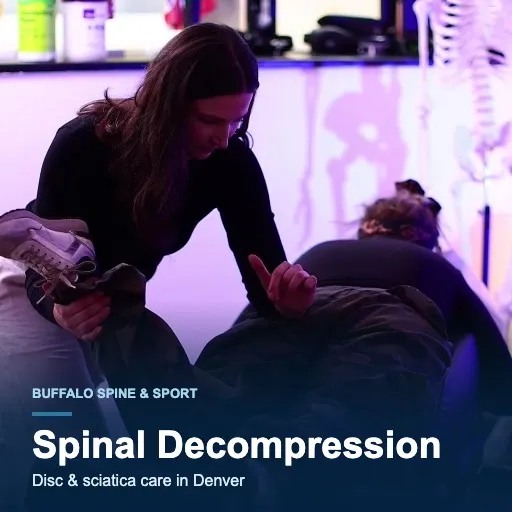
Spinal Decompression in Denver | DOC Table for Disc Pain
Spinal Decompression in Denver: How the DOC Table Helps Disc Pain Without Surgery
If you've been told you have a bulging disc, a herniated disc, or sciatica, you've probably heard the options framed as two choices: live with it or get surgery. For a lot of people there's a very reasonable step in between. At Buffalo Spine & Sport Chiropractic in Denver, we use the DOC spinal decompression table to take pressure off irritated discs and nerves, and for many of our patients it's what finally gets them back to work, back to the gym, and back to sleeping through the night.
This guide covers what spinal decompression is, how our DOC table works, who's a good candidate (and who isn't), and what to expect when you come in.
What is spinal decompression? Spinal decompression is a nonsurgical treatment that uses a computer controlled table to gently stretch the spine in slow, repeated cycles. The goal is to lower pressure inside the disc, create space for pinched nerves, and help water and nutrients move back into the disc so it has a better environment to heal.
How does spinal decompression work?
Each disc in your spine has a soft, gel-like center surrounded by a tough outer ring. Discs don't have much of a direct blood supply, so they rely on movement and changes in pressure to pull in fluid and nutrients. When a disc bulges or herniates, that center pushes outward and can press on a nearby nerve. That's what causes the burning, shooting, or numb feeling down a leg (sciatica) or down an arm.
During decompression, the table slowly applies a pulling force to a specific area of your spine, holds it, then partially releases. That cycle repeats throughout the session. Research on decompression has shown this kind of controlled distraction can lower the pressure inside the disc, which may help draw bulging material back toward the center and pull fluid into the disc. Less pressure on the disc usually means less pressure on the nerve, and that's where people start to feel the difference.
How is spinal decompression different from traction or an inversion table?
Old fashioned traction pulls with a steady, constant force. The problem is that your body tends to fight a sudden or constant stretch. The muscles along your spine tighten up to protect you – we call this guarding – and that tension works against the whole point of the treatment.
Decompression is designed to avoid that. The pull ramps up gradually, holds, and eases off before your muscles have a reason to fight back, and the computer tracks the force the whole time.
Inversion tables are a different story altogether. They stretch the entire spine using gravity, they can't target a specific disc level, and aren't a good idea for people with high blood pressure, glaucoma, or heart problems.
Why we use the DOC decompression table
Not all decompression tables are built the same, and the equipment matters. We chose the DOC table because it lets us be precise with each patient instead of running everyone through the same program.
The DOC system has separate programming for lumbar and cervical decompression, so we can tailor treatment to your low back or your neck, and it monitors and graphs the treatment in real time so we can adjust as we go. We can also set custom hold and relax times and adjust the speed of the pull based on how your body responds. We meet your spine where it is, which makes treatment more comfortable and more targeted.
What conditions can spinal decompression help?
We most often use decompression for herniated and bulging discs in the low back and neck, sciatica, degenerative disc disease, pinched nerves causing arm or leg pain, facet related pain, and some cases of spinal stenosis.
That said, decompression isn't the right fit for every back problem, and we'd rather tell you that up front than sell you a program that won't help. Muscle strains, for example, usually respond better to other care.
Who should not have spinal decompression?
Decompression is gentle, but there are situations where we won't use it. These include pregnancy, spinal fusion with hardware, recent fractures, tumors or infection in the spine, and severe osteoporosis. Certain types of spinal instability also rule it out.
There are also warning signs that need emergency care rather than a chiropractic visit: loss of bladder or bowel control, numbness in the groin or inner thighs, or leg weakness that's getting worse quickly. If you have any of those, go to the ER. This is exactly why every decompression patient at our clinic starts with a full exam before we ever put them on the table.
What does a spinal decompression session feel like?
Most patients are surprised by how relaxing it is. You'll lie on the table, usually on your back with your knees supported, and we'll fit you with a harness around your hips or a cradle for your neck. Once everything is set, the table begins its cycles. You'll feel a gradual stretch, a hold, and a gentle release.
A session typically runs about 30 to 45 minutes. It shouldn't hurt. Some people feel a little sore after the first couple of visits as the area adjusts, similar to how you'd feel after a new workout. We'll also give you guidance on movement, positions to avoid, and simple exercises so you're supporting the progress between visits.
How many spinal decompression sessions will I need?
It depends on what's going on in your spine, how long it's been going on, and how your body responds. Many treatment plans fall somewhere around 6 to 12 visits over four to six weeks, with more frequent visits at the start. We reassess along the way, so your plan changes based on your progress instead of a fixed number on a sheet.
Some patients notice a change within the first handful of sessions. Disc healing takes longer than pain relief, though, so finishing the plan matters even after you start feeling better.
Frequently asked questions about spinal decompression
Does spinal decompression hurt?
No. Treatment should feel like a gentle stretch. If anything feels uncomfortable, we adjust the settings right away.
Can spinal decompression help sciatica?
Yes, when sciatica is caused by a disc pressing on a nerve root, decompression is one of the conditions it's best suited for.
Does it work for neck pain?
Yes. The DOC table has dedicated cervical programming for disc problems and pinched nerves in the neck, including pain, tingling, or numbness that travels into the arm.
Can I have decompression after back surgery?
It depends on the surgery. Spinal fusion with hardware usually rules it out, while some other procedures may not. We'll review your surgical history during your evaluation.
Is spinal decompression right for you? Start with an evaluation
The first step is a spinal decompression evaluation at our Denver office. We'll go over your history, run orthopedic and neurological tests, review any imaging you have, and let you know whether you're a good candidate. If you are, we'll walk you through a plan built around your spine. If you're not, we'll tell you and point you toward care that makes more sense.
To schedule, call Buffalo Spine & Sport Chiropractic at 720.916.8625 or visit us at 130 Rampart Way, Suite 110, Denver, CO 80230.
Living with disc pain isn't your only option, and surgery doesn't have to be the next one.