
INSTRUMENT-ASSISTED SOFT TISSUE CARE IN DENVER
GRASTON TECHNIQUE TO HELP YOU MOVE & IMPROVE
Restore tissue glide, accelerate recovery, and eliminate chronic movement restrictions through precision Graston Technique and instrument-assisted soft tissue therapy. Personalized clinical protocols designed for Denver's active community.
Buffalo Spine & Sport Chiropractic · Lowry & Greater Denver, Colorado
THE TECHNIQUE
WHAT IS THE GRASTON TECHNIQUE?
DIRECT CLINICAL DEFINITION
The Graston Technique is an evidence-based form of Instrument-Assisted Soft Tissue Mobilization (IASTM) using specialized stainless steel instruments with curvilinear beveled edges. Clinicians use these instruments to detect and treat soft-tissue fibrosis, chronic inflammation, and fascial restrictions, stimulating localized microvascular remodeling, collagen realignment, and accelerated tissue healing.
When connective tissues experience trauma or repetitive stress, unorganized scar tissue and dense adhesions restrict healthy joint biomechanics. By applying precise, multi-directional cross-friction strokes across dysfunctional fibers, instruments isolate adhesions that manual touch alone cannot pinpoint. This mechanical input triggers cellular turnover and nervous system re-education.
Clinical Standard: At Buffalo Spine & Sport, Graston Technique is a tool - not a one-size-fits-all treatment plan. We pair soft-tissue release with active movement loading and neuromuscular stabilization for lasting athletic durability.
UNDERSTANDING THE TERMINOLOGY
IS GRASTON TECHNIQUE THE SAME AS IASTM?
The short answer: Graston Technique is a trademarked, patented brand of manual therapy that falls under the broader clinical umbrella of IASTM (Instrument-Assisted Soft Tissue Mobilization). Think of IASTM as the medical methodology, while Graston is one specific instrument line and educational protocol.
Both approaches utilize precision stainless steel instruments to detect and treat soft-tissue fibrosis, muscle restrictions, and chronic myofascial adhesions. At Buffalo Spine & Sport Chiropractic, our clinicians utilize advanced IASTM protocols to provide targeted, evidence-based recovery.
- IASTM is the overarching, evidence-based clinical modality.
- Graston Technique represents a proprietary set of 6 contoured stainless steel tools.
- Both share the core mechanism of targeted mechanotransduction and microvascular stimulation.
CLINICAL DEFINITION CARD
IASTM (n.)
Instrument-Assisted Soft Tissue Mobilization: A therapeutic intervention using ergonomic, beveled instruments to apply controlled micro-trauma to affected soft tissue, accelerating local blood flow and cellular repair.
Hierarchy:
Manual Therapy > IASTM (Methodology) > Graston (Brand)
CLINICAL PROCESS & WORKFLOW
HOW DOES INSTRUMENT-ASSISTED SOFT TISSUE TREATMENT WORK?
Instrument-assisted soft tissue mobilization operates through controlled microvascular stimulation. By gliding beveled surgical-grade instruments across targeted kinetic chains, clinicians identify micro-adhesions, initiate cellular fibroblast repair, release restrictive fascial cross-links, and immediately reinforce restored range with active neuromuscular loading.
STEP 01
IDENTIFY
Ergonomic beveled steel surfaces resonate through acoustic tactile feedback, pinpointing dense fibrotic adhesions and collagen cross-linking undetectable by manual touch alone.
STEP 02
TREAT
Targeted mechanical shear stress creates a controlled micro-inflammatory response, stimulating local fibroblast proliferation, nutrient perfusion, and cellular reorganization.
STEP 03
MOVE
Immediate active range-of-motion drills and loaded eccentric exercises take advantage of newly freed tissue planes to re-establish clean neuromuscular firing patterns.
STEP 04
PROGRESS
Systematic load tolerance progressions guarantee newly organized collagen fibers mature along physiological force vectors, sustaining durable, pain-free athletic performance.
WHEN IT MAY BE USED
WHAT CONDITIONS MAY BE TREATED WITH IASTM?
Instrument Assisted Soft Tissue Mobilization is applied based on active movement evaluation, tissue responsiveness, and functional restriction - not merely a diagnostic label. Below are common presentations where targeted mechanical input supports recovery.
UPPER BODY & TENDON PRESENTATIONS
- Lateral epicondylopathy (Tennis elbow) & gripping overload
- Medial epicondylopathy (Golfer's elbow) & wrist flexor tension
- Rotator cuff tendinopathy & scapular motion restrictions
- Acute & chronic cervical / thoracic postural muscular strains
- Carpal tunnel adjacent soft tissue density & forearm tightness
Targeted instrument contact helps modulate local pain signals and prepares upper extremity soft tissue for progressive loading exercises.
LOWER BODY & OVERUSE SYNDROMES
- Iliotibial (IT) band friction & lateral hip / knee sensitivity
- Plantar fasciopathy & deep intrinsic foot tension
- Achilles tendinopathy & calf complex tightness / stiffness
- Patellar tendinopathy ('Jumper's Knee') & quadriceps strain
- Post-activity hamstring & adductor muscle strain recovery
Applied alongside gait and movement assessments to restore tissue tolerance and joint mechanics during weight-bearing activities.
Clinical Note: IASTM is a supportive component within a comprehensive care plan, never an isolated standalone fix.
UNDERSTANDING SOFT TISSUE
WHAT IS SCAR TISSUE - AND DOES GRASTON "BREAK IT UP"?
A widespread clinical misconception claims that stainless-steel IASTM tools physically shred, scrape, or dissolve dense collagen adhesions under the skin. In reality, mature human scar tissue requires thousands of pounds of mechanical force to tear. Therapeutic instruments do not mechanically grind away tissue - they deliver a targeted neuro-sensory and micro-vascular stimulus that resets how your nervous system perceives threat and regulates local tissue tension.
THE GOAL IS NOT TO SCRAPE AWAY YOUR PAIN
True therapeutic efficacy comes from improving tissue tolerance, lubricating fascial sliding planes, and dampening overactive pain receptors. Instead of aggressive, bruise-inducing friction, precise bevel-edge treatment stimulates cellular fibroblastic activity and increases local micro-circulation, allowing restricted joints and muscles to move without pain-protective guarding.
- Neuro-Sensory Modulation: Down-regulates central nervous system pain signaling and decreases hypertonic muscle tone.
- Fascial Glide Restoration: Rehydrates ground substance to allow adjacent muscle layers to slide friction-free.
- Controlled Cellular Signaling: Promotes fibroblastic proliferation and realigns collagen matrix through gentle movement.
MODERN PAIN SCIENCE
MECHANICAL MYTH VS. CLINICAL REALITY
OUTDATED BELIEF
"Heavy pressure breaks apart physical scar tissue clumps and forces adhesions to dissolve."
EVIDENCE-BASED TRUTH
"Precise tactile input stimulates mechanoreceptors, increases vascular perfusions, and restores movement confidence without unnecessary tissue trauma."
CLINICAL RESULT: Rapid restoration of pain-free range of motion without bruising.
PATIENT EXPECTATIONS & COMFORT
WHAT DOES GRASTON TECHNIQUE FEEL LIKE?
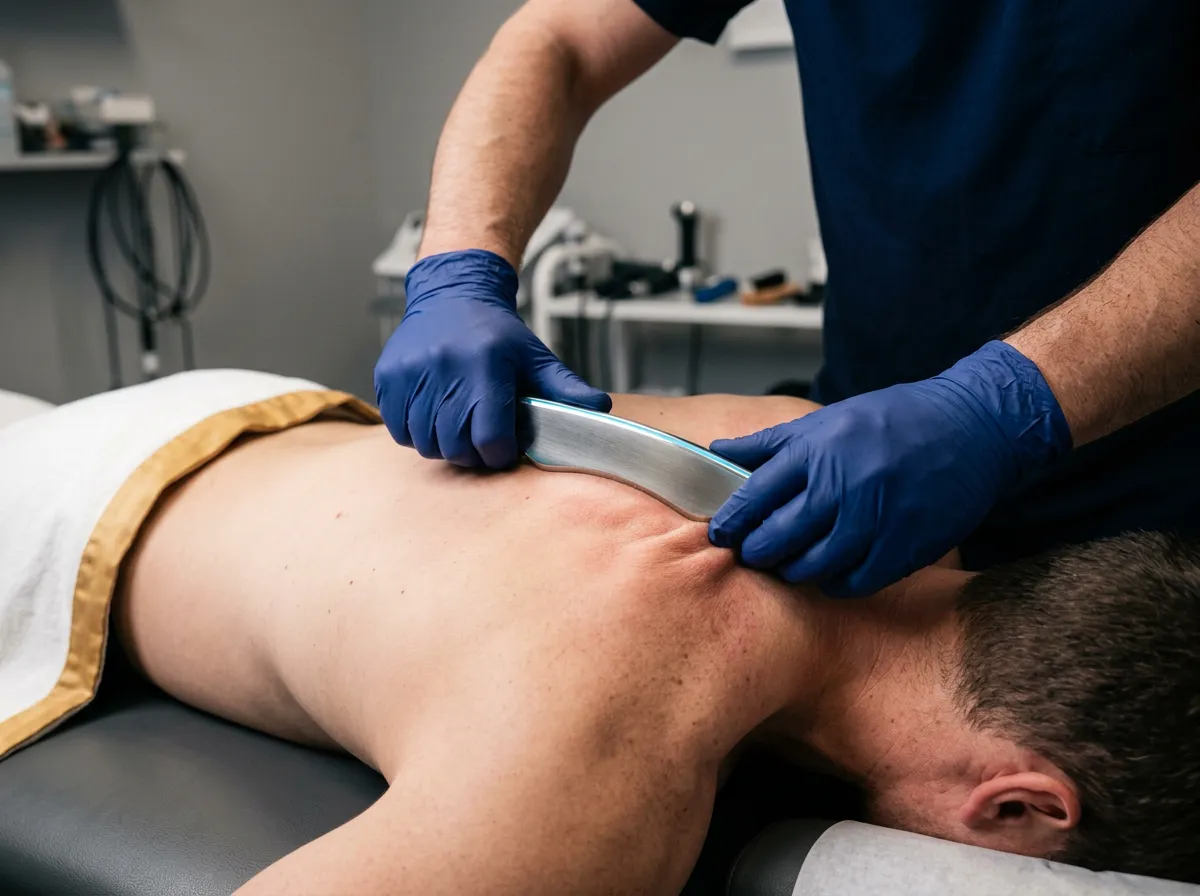
Modern instrument-assisted soft tissue mobilization is an interactive, calibrated therapy. Here is exactly what you can expect on the treatment table.
SENSATION PROFILE
CONTROLLED PRESSURE AND TISSUE FEEDBACK
Patients often describe the initial scan as a distinctive 'gravelly' or vibrating sensation as the beveled instrument glides over tight fascial restrictions. This mechanical resonance helps our clinicians pinpoint exact areas of dysfunction without aggressive force.
- Mild, diagnostic pressure tailored to your tissue sensitivity
- A localized warming sensation from stimulated micro-circulation
- Immediate release of muscle guarding and restored joint glide
CLINICAL MYTHBUSTING
DEBUNKING THE 'BRUISING EQUALS HEALING' MYTH
Outdated soft-tissue methods mistakenly promoted significant bruising as a sign of efficacy. In modern evidence-based chiropractic, excessive force induces trauma rather than repair. Our goal is controlled neurological and cellular stimulation, never collateral damage.
- Mild temporary redness (erythema) is normal; heavy bruising is avoided
- Continuous two-way dialogue ensures pressure stays within your comfort zone
- Immediate functional exercises solidify range of motion gains without pain

YOUR TREATMENT PLAN
A PLAN BUILT AROUND HOW YOU MOVE
Instruments accelerate recovery, but long-term athletic resilience requires a systematic three-stage clinical model.
PHASE 01
01 - ASSESS
Comprehensive kinetic evaluation to pinpoint specific fascial restrictions, joint mechanics, and functional movement compensations before applying any tool.
PHASE 02
02 - TREAT
Precise instrument-assisted soft tissue mobilization to down-regulate acute pain receptors, introduce microvascular profusion, and restore normal tissue glide.
PHASE 03
03 - PROGRESS
Targeted active loading, neuromuscular re-education, and sport-specific biomechanical training to lock in structural gains and safeguard against re-injury.
Your treatment isn't built around a tool. It's built around helping you return to the activities that matter to you.
MULTIDISCIPLINARY CLINICAL INTEGRATION
IASTM MAY BE ONE PART OF YOUR RECOVERY PLAN
Evidence-Based Tools for Targeted Tissue Repair
Instrument-assisted soft tissue mobilization rarely stands alone. At Buffalo Spine & Sport Chiropractic, we combine targeted mechanical shear with advanced clinical modalities to accelerate cellular healing, restore joint mechanics, and permanently resolve movement restrictions.
- IASTM rapidly desensitizes focal adhesions and down-regulates local nociceptive tone
- Joint manipulation restores physiological range and optimal arthrokinematics
- Loaded exercise and neuromuscular rehab lock in permanent biomechanical resilience
MANUAL + JOINT CARE
High-velocity chiropractic adjustments and joint mobilizations restore anatomical alignment while IASTM smooths periarticular fascial tension.
RELATED SERVICE: Spinal & Extremity Adjusting
DRY NEEDLING & SHOCKWAVE
Deep neuromuscular trigger points and recalcitrant chronic tendinopathies receive focused acoustic pulse stimulation and direct micro-lesion therapy.
RELATED SERVICE: Trigger Point Dry Needling
MOVEMENT & ACTIVE REHAB
Progressive eccentric loading and dynamic movement patterning reorganize new collagen matrices along direct lines of functional stress.
RELATED SERVICE: Functional Athletic Rehab
CLASS IV LASER THERAPY
High-photon photobiomodulation penetrates deep into compromised tissues, stimulating ATP synthesis and dramatically reducing acute inflammatory cascades.
RELATED SERVICE: Photobiomodulation Therapy
MOVEMENT MATTERS
FROM EVERYDAY MOVEMENT TO ATHLETIC PERFORMANCE
Manual therapy is only as effective as the functional freedom it restores. Whether you are navigating steep Colorado trails, hitting personal bests in the gym, or keeping up with your family pain-free, our clinical soft-tissue protocols are calibrated to mirror the real-world demands placed on your body.
WHY BUFFALO SPINE & SPORT?
THE RIGHT TOOL FOR THE RIGHT PATIENT.
We do not believe in one-size-fits-all chiropractic care. Every protocol is custom-selected based on comprehensive movement diagnostics, clinical presentation, and your active lifestyle targets.
01
INDIVIDUALIZED EVALUATION
Precise orthopaedic and kinematic assessments ensure we pinpoint the root dysfunction rather than merely masking local symptoms.
02
EVIDENCE-INFORMED CARE
We utilize peer-reviewed soft tissue and manual therapy frameworks validated for tissue remodeling and accelerated recovery.
03
MOVEMENT + FUNCTION
Restoring full joint mobility and motor recruitment so you return immediately to running, lifting, and everyday athletic pursuits.
04
MULTIPLE TREATMENT OPTIONS
IASTM, joint manipulation, dry needling, and functional rehab combined under one roof to give you the ideal intervention.
HELPING YOU MOVE AND IMPROVE.
Denver's athletic chiropractic destination for evidence-informed recovery and sustainable performance.
LOCAL CLINIC ACCESS & REGIONAL REACH
GRASTON TECHNIQUE & IASTM IN DENVER, COLORADO
Centrally positioned in East Denver's historic Lowry district, Buffalo Spine & Sport provides evidence-based instrument assisted soft tissue therapy for athletes, weekend warriors, and active professionals across the Denver metro corridor.
LOWRY CLINICAL HEADQUARTERS
Located in Denver's Lowry neighborhood, Buffalo Spine & Sport Chiropractic provides personalized chiropractic care, sports injury rehabilitation, and non-surgical treatment options to help patients improve mobility, manage pain, and return to the activities they enjoy.
Our clinic is conveniently located at 130 Rampart Way, Suite 110, Denver, CO 80230, with on-site parking available for patients.
CONVENIENTLY SERVING DENVER & SURROUNDING COMMUNITIES
Lowry & Crestmoor
Cherry Creek North
Hilltop & Montclair
Washington Virginia Vale
Mayfair & East Colfax
Central Park
Congress Park & Hale (8 min)
Cherry Creek
Western Aurora
South Park Hill
EASY PARKING & CLINIC ACCESS
Free on-site parking is available on the right side of the building. Enter through the main front entrance; our office is located to the left of the main lobby in Suite 110.

BUFFALO SPINE & SPORT CHIROPRACTICLowry Medical Building, 8155 E 1st Ave, Suite 100, Denver, CO 80230
CLINICAL KNOWLEDGE BASE
QUESTIONS ABOUT GRASTON TECHNIQUE & IASTM
Explore direct, clinician-reviewed answers regarding treatment sensations, session parameters, recovery windows, and care protocols at our Denver clinic.
Have a specific case question? Call our Denver team directly at (720) 916-8625.
Is Graston Technique painful during treatment?
Graston Technique is not intended to be painful. Patients typically feel localized pressure and mild friction as the instrument glides across restricted fascial planes. Our clinicians continuously modulate stroke depth and instrument angle to maintain comfort within a productive therapeutic threshold, avoiding unnecessary distress.
Why does bruising happen with IASTM, and is it necessary?
Bruising (ecchymosis) is neither a therapeutic goal nor a requirement for clinical success with IASTM. While mild redness (petechiae) often indicates increased microcirculation and localized tissue perfusion, heavy bruising reflects excessive mechanical force. Modern evidence-based protocols emphasize precise, low-trauma mechanical stimulation to trigger healing without soft tissue damage.
How many IASTM sessions will I need to see results?
Most patients experience noticeable improvements in range of motion and pain reduction within 3 to 6 sessions. Acute muscular restrictions often resolve faster, whereas chronic tendinopathies and dense fibrotic adhesions may require 6 to 10 treatments combined with progressive loading exercises for optimal remodeling.
How often should I receive Graston Technique treatments?
Standard clinical protocols schedule treatments twice weekly with 48 to 72 hours between visits. This spacing gives local fibroblasts adequate time to synthesize new collagen while allowing mild post-treatment tissue sensitivity to normalize before the next therapeutic application.
Can I work out immediately after an IASTM session?
Light active mobility, corrective drills, and low-intensity cardio are encouraged immediately following treatment to integrate newly gained joint excursion. However, heavy eccentric loading and maximum-effort athletic training should be avoided for 24 hours to support cellular repair.
What conditions respond best to instrument-assisted soft tissue mobilization?
IASTM delivers strong clinical outcomes for plantar fasciitis, Achilles tendinopathy, lateral epicondylitis (tennis elbow), rotator cuff tendonitis, IT band friction syndrome, patellar tendinopathy, and post-surgical scar restrictions affecting joint biomechanics.
Where is Buffalo Spine & Sport Chiropractic located in Denver?
Buffalo Spine & Sport Chiropractic is centrally located in Denver, Colorado, providing accessible clinical care for athletes and active residents throughout Central Denver, Cherry Creek, Lowry, Capitol Hill, and surrounding metro communities.
How does Graston Technique differ from standard deep tissue massage?
Standard massage uses broad, compressive force from human hands. Graston Technique employs beveled stainless steel instruments that amplify tactile feedback, allowing clinicians to isolate microscopic tissue densities and treat targeted fascial layers with far greater geometric precision.
Is IASTM safe for acute sports injuries or just chronic conditions?
IASTM is effective for both stages when applied appropriately. In acute phases, gentle peripheral strokes reduce protective guarding and edema. In chronic conditions, firmer strokes stimulate localized fibroblast proliferation and reorganizes misaligned collagen fibers.
What should I do to prepare for my first Graston appointment?
Wear athletic clothing that allows unobstructed access to the injured area. Hydrate adequately prior to your visit, as hydrated fascial networks respond more efficiently to mechanical shear forces and exhibit less post-treatment sensitivity.
Does instrument-assisted therapy actually break down scar tissue?
IASTM does not physically crush dense fibrous tissue. Instead, mechanical shear stimulates cellular mechanoreceptors, down-regulates pain signaling, and initiates controlled micro-vascular remodeling that helps reorganize disorganized collagen fibrils over progressive loading cycles.
Can Graston Technique help with chronic plantar fasciitis and Achilles tendonitis?
Yes. Plantar and Achilles pathologies feature degenerative collagen changes. Graston Technique introduces targeted mechanotherapy to promote cellular turnover, while restoring ankle dorsiflexion and calf compliance required for normal gait mechanics.
What makes Buffalo Spine & Sport's approach to IASTM unique in Denver?
We never treat IASTM as an isolated modality. At Buffalo Spine & Sport, instrument mobilization is strictly paired with active neuro-motor re-education, specific eccentric loading, and chiropractic joint adjustments to deliver lasting functional performance.
Are there any contraindications where IASTM should not be performed?
IASTM is contraindicated over open wounds, unhealed fractures, acute deep vein thrombosis, active skin infections, uncontrolled coagulopathies, and localized malignancies. A comprehensive orthopedic assessment precedes every treatment to ensure patient safety.
How do I book an initial IASTM evaluation in Denver?
You can schedule your initial evaluation online through our direct booking portal or by contacting our Denver clinic front desk. Same-week appointments are prioritized for athletes and patients dealing with acute movement limitations.
START WITH THE RIGHT ASSESSMENT
LET'S BUILD A PLAN
FOR YOUR RECOVERY.
Address stubborn soft tissue restrictions, break free from chronic stiffness, and restore natural biomechanics with targeted clinical IASTM and active rehabilitation.
Direct 1-on-1 Chiropractic Care • Evidence-Based Protocols • Denver, CO
Buffalo Spine & Sport Chiropractic | 1200 Lincoln St, Denver, CO 80203 | Mon–Fri: 7:30 AM – 6:00 PM

At Buffalo Spine & Sport Chiropractic, we are evidence-based chiropractic rehabilitation and athletic sports medicine focused on biomechanical recovery, spine health, and sustainable performance.
Our Location
130 rampart Way,
Suite 110
Denver, CO 80230
Phone Number:
(720) 916-8625
Business Hours
Medical Disclaimer: The information provided on this website is for informational and educational purposes only and does not constitute medical diagnosis, treatment, or specific clinical advice. Evaluation by a licensed chiropractic physician is required prior to initiating any treatment plan. Buffalo Spine & Sport Chiropractic operates strictly as a fee-for-service / direct-pay practice.
© 2026 Buffalo Spine & Sport Chiropractic. All Rights Reserved. | Privacy Policy | Terms of Conditions | HIPAA Notice | Direct-Pay Financial Agreement